Guides · October 13, 2026
Outdoor wedding checklist: rain plan, lightning, heat and permits
An outdoor wedding is two plans: the one you want and the one you use if the sky disagrees. The second plan is cheap to make early and expensive to improvise. The safety guidance here comes from federal agencies. The permit figures are real examples, and your city, county or park sets its own.
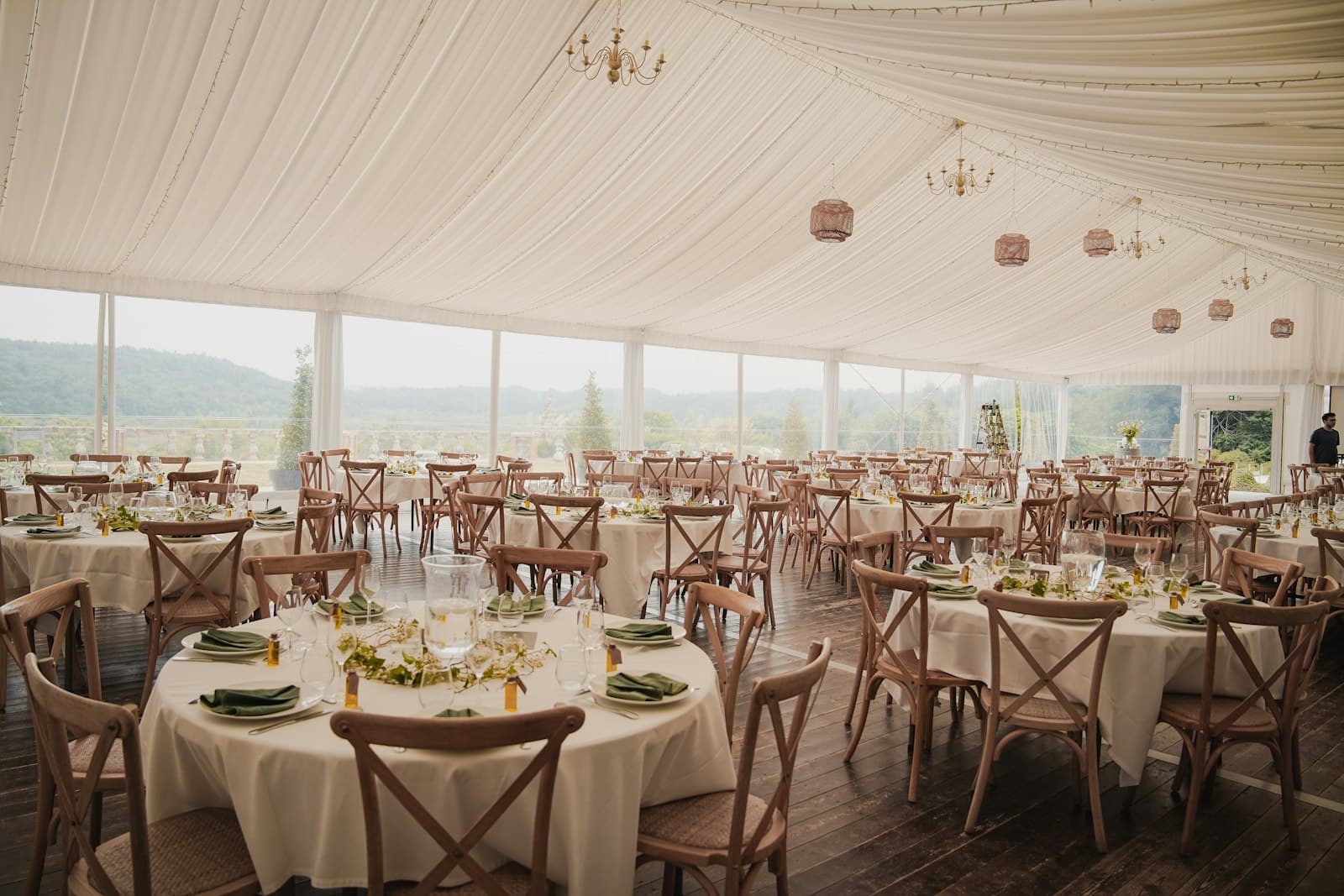
Decide the rain plan before you book
The Knot's guide to rain plans says to start thinking about it before you even choose a venue. The reason is practical: whether the venue has an indoor room, and whether that room is included in the price, is part of what you are buying. Zola's guide calls confirming that a must.
- If a tent is the backup, The Knot says the safest move is to reserve it around the time you book the venue. A planner quoted there says her rental partner will hold one with a deposit.
- Waiting has a cost: rental companies can sell out when everyone sees the same forecast.
- The same planner plans for four things: rain, wind, heat and smoke.
- No published guide we read gives a fixed deadline for the final call. Ask the tent company and the venue for theirs, and agree who decides.
Lightning: the one rule with no flexibility
The National Weather Service puts it in four words: when thunder roars, go indoors. If you can hear thunder, you are likely within striking distance of the storm.
- Safe shelter is a substantial building with electricity or plumbing, or an enclosed, metal-topped vehicle with the windows up.
- The Service says tents and open picnic shelters are not safe places. Its wording is about camping tents and shelters, and it gives no exception for larger ones.
- Wait at least 30 minutes after the last thunder before going back outside.
- For organized outdoor events, it recommends having a lightning plan and following it without exception, and notes that large groups need extra time to reach shelter.
Heat
The heat index is how hot it feels once humidity is counted. The Weather Service notes that the values assume shade and a light wind, and that full sunshine can add up to 15°F.
| Heat index | National Weather Service category |
|---|---|
| 80°F to 90°F | Caution: fatigue possible with prolonged exposure |
| 90°F to 103°F | Extreme caution: heat cramps or heat exhaustion possible |
| 103°F to 124°F | Danger: heat cramps or exhaustion likely, heat stroke possible |
| 125°F or higher | Extreme danger: heat stroke highly likely |
- The CDC says people aged 65 or older are more prone to heat-related health problems. Give older guests the shaded seats.
- Put water out before the ceremony. The advice from both agencies is to drink before you feel thirsty.
- EPA's UV Index guidance says to seek shade from late morning through mid-afternoon when the index is 3 or higher.
Wind and the tent
There is no national wind limit for tents. The Weather Service issues wind advisories by local criteria, and tent rules come from local fire codes. One example: the fire marshal of Grand Haven, Michigan does not allow a tent to be occupied if gusts over 35 mph are forecast. Ask your tent company what their tent is rated for and when they would have you clear it.
Tent permits: three real thresholds
Three places, three numbers. Seattle also asks for the application 30 days ahead, allows only electric heaters inside a tent and keeps propane heaters at least 10 feet away. Your tent company usually knows the local rule. Ask who files the permit.
| Place | A permit is required when the tent is |
|---|---|
| Howard County, Maryland | Over 120 square feet |
| Seattle, Washington | Over 400 square feet (larger if open on all sides) |
| Fairfax County, Virginia | 901 square feet or more, or for 50 or more people |
Getting married in a national park
The four parks we read all require a special use permit for any wedding, and none of them closes the area to other visitors for you. Fees and limits as published in September and October 2026:
| Park | Application fee | Worth knowing |
|---|---|---|
| Great Smoky Mountains | $50 | Outdoor sites: 25 people, 1 hour, 6 vehicles. No weather refunds |
| Grand Canyon | $70 | Two-hour block. No arches, chairs or amplified sound |
| Yosemite | $150 | Up to two hours. No decorations, chairs or amplified music |
| Rocky Mountain | $300 | 30 people at most. Apply up to a year ahead |
- Applications open up to a year in advance.
- Throwing rice, petals or birdseed is prohibited in the parks that mention it.
- Drones are prohibited in national parks, with few exceptions.
Drones everywhere else
Outside the parks, the FAA's Part 107 rule covers flying a drone for work or business and requires a certified remote pilot. The FAA says payment is not what decides whether a flight is recreational, and its own advice is: when in doubt, assume Part 107. Ask your photographer or videographer to show their certificate.
Pick the date with thirty years of data
- NOAA publishes climate normals, the 30-year averages of temperature and rainfall, for about 15,000 US weather stations, by month and by day.
- A normal is what is typical, not a forecast.
- The Atlantic hurricane season runs from June 1 to November 30 and peaks around September 10. Most activity falls between mid-August and mid-October.
The unglamorous list
- Restrooms: The Knot gives two rules of thumb, one stall for every 35 guests and one for every 25. Ask the rental company what it recommends for your count.
- Restroom trailers need level ground, power and water, and The Knot says most are reserved 6 to 18 months ahead.
- Power: no indoor kitchen usually means a generator, supplied and set up by an electrical company.
- Light for paths, parking and restrooms.
- Ground: tell guests what they will be walking on, and plan a firm path for wheelchairs and canes.
- Sound: check the local noise ordinance and tell the neighbors.
Sources:
- National Weather Service, Lightning Safety Tips
- National Weather Service, Lightning Safety Outdoors
- National Weather Service, Lightning Safety and Outdoor Sports Activities
- National Weather Service, Heat Forecast Tools
- National Weather Service Amarillo, What Is the Heat Index?
- National Weather Service, Wind Warnings, Watches and Advisories
- CDC, Heat and Older Adults (Jun 2024)
- EPA, UV Index Scale (Jun 2026)
- NOAA NCEI, U.S. Climate Normals
- NOAA National Hurricane Center, Tropical Cyclone Climatology
- Yosemite National Park, Weddings (Oct 2026)
- Rocky Mountain National Park, Weddings (Sep 2026)
- Great Smoky Mountains National Park, Wedding Permits (Sep 2026)
- Grand Canyon National Park, Special Use Permits (Sep 2026)
- National Park Service, Uncrewed Aircraft in the National Parks (May 2025)
- FAA, Recreational Flyers (Mar 2026)
- Seattle Fire Department, Tents and Flameproofing
- Fairfax County Fire Marshal, Tents
- Howard County Fire and Rescue, Special Events
- Grand Haven Fire Marshal, Temporary Tents Permit Application (2026)
- The Knot, Your Guide to Creating an Outdoor Wedding Rain Plan (Apr 2023)
- The Knot, How to Plan an Outdoor Wedding (Nov 2025)
- The Knot, Bathroom Rentals for Weddings (Oct 2024)
- Zola, How to Plan an Outdoor Wedding: 32 Tips (Feb 2024)
General information for planning, not legal or financial advice. My Wedding Plan is independent and not affiliated with the sources cited.